
Exploring Factors Associated With Complications Among Persons With Spinal Cord Injury Undergoing Surgical Closure of Stage 4 Pelvic Pressure Injuries
DOI:
https://doi.org/10.63354/cjwoc.v1i3.15939Keywords:
Pressure injury, surgical reconstruction, spinal cord injury, complications, risk factorsAbstract
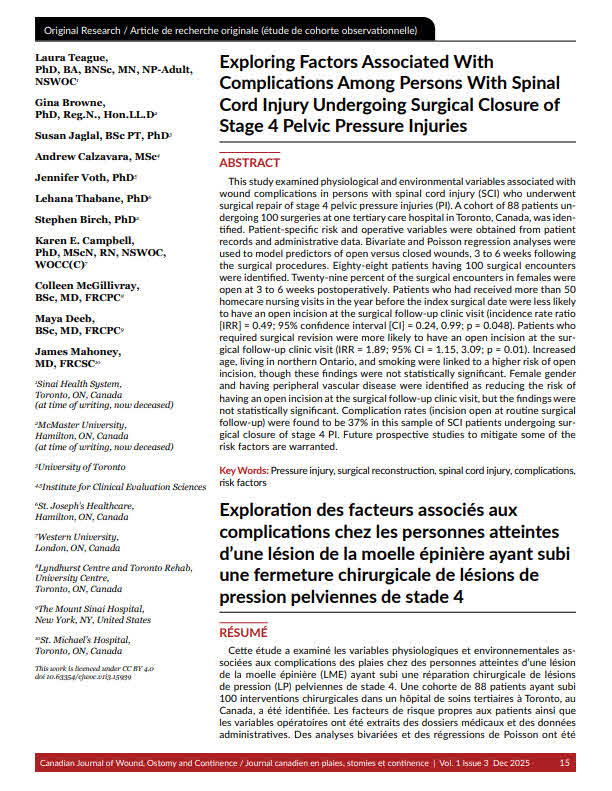
This study examined physiological and environmental variables associated with wound complications in persons with spinal cord injury (SCI) who underwent surgical repair of stage 4 pelvic pressure injuries (PI). A cohort of 88 patients undergoing 100 surgeries at one tertiary care hospital in Toronto, Canada, was identified. Patient-specific risk and operative variables were obtained from patient records and administrative data. Bivariate and Poisson regression analyses were used to model predictors of open versus closed wounds, 3 to 6 weeks following the surgical procedures. Eighty-eight patients having 100 surgical encounters were identified. Twenty-nine percent of the surgical encounters in females were open at 3 to 6 weeks postoperatively. Patients who had received more than 50 homecare nursing visits in the year before the index surgical date were less likely to have an open incision at the surgical follow-up clinic visit (incidence rate ratio [IRR] = 0.49; 95% confidence interval [CI] = 0.24, 0.99; p = 0.048). Patients who required surgical revision were more likely to have an open incision at the surgical follow-up clinic visit (IRR = 1.89; 95% CI = 1.15, 3.09; p = 0.01). Increased age, living in northern Ontario, and smoking were linked to a higher risk of open incision, though these findings were not statistically significant. Female gender and having peripheral vascular disease were identified as reducing the risk of having an open incision at the surgical follow-up clinic visit, but the findings were not statistically significant. Complication rates (incision open at routine surgical follow-up) were found to be 37% in this sample of SCI patients undergoing surgical closure of stage 4 PI. Future prospective studies to mitigate some of the risk factors are warranted.
References
1. Houghton PE, Campbell KE, CPG Panel. Canadian Best Practice Guidelines for the Prevention and Management of Pressure Ulcers in People With Spinal Cord Injury. A Resource Handbook for Clinicians. February 2013. Accessed December 12, 2025. www.estim4wounds.ca/wp-content/uploads/TheCanadianBPGforPreventionandManagementofPressureUlcersinPeoplewithSCI.pdf
2. Dorsett P, Geraghty T. Health-related outcomes of people with spinal cord injury: a 10-year longitudinal study. Spinal Cord. 2008;46(5):386-391.
3. Garber SL, Rintala DH. Pressure ulcers in veterans with spinal cord injury: a retrospective study. J Rehabil Res Dev. 2003;40(5):433-441.
4. Hitzig SL, Tonack M, Campbell KA, et al. Secondary health complications in an aging Canadian spinal cord injury sample. Am J Phys Med Rehabil. 2008;87(7):545-555. doi: 10.1097/PHM.0b013e31817c16d6
5. Chen Y, DeVivo MJ, Jackson AB. Pressure ulcer prevalence in people with spinal cord injury: age–period–duration effects. Arch Phys Med Rehabil. 2005;86(6):1208-1213.
6. Saunders LL, Krauze JS, Acuna J. Association of race, socioeconomic status, and health care access with pressure ulcers after spinal cord injury. Arch Phys Med Rehabil. 2012;93(6):972-977.
7. Chan B, Nanwa N, Mittman N, Bryant D, Coyte PC, Houghton PE. The average cost of pressure ulcer management in a community dwelling spinal cord injury population. Int Wound J. 2013;10(4):431-440. doi:10.1111/j/1742-481X.2012.01002.x
8. Brem H, Maggi J, Nierman D, et al. High cost of stage IV pressure ulcers. Am J Surg. 2010;200(4):473–477.
9. Demarré L, Van Lancker A, Van Hecke A, et al. The cost of prevention and treatment of pressure ulcers: a systematic review. Int J Nurs Stud. 2015;52(11):1754-1774.
10. Filius A, Damen THC, Schuijer-Maaskant KP, Polinder S, Hovius SER, Walbeehm ET. Cost analysis of surgically treated pressure sores stage III and IV. J Plast Reconstr Aesthet Surg. 2013 Nov;66(11):1580-1586. doi:10.1016/j.bjps.2013.05.014
11. National Pressure Ulcer Advisory Panel, European Pressure Ulcer Advisory Panel. Prevention and Treatment of Pressure Ulcers: Clinical Practice Guidelines. National Pressure Ulcer Advisory Panel; 2019
12. Ahluwalia R, Martin D, Mahoney JL. The operative treatment of pressure wounds: a 10-year experience in flap selection. Int Wound J. 2010;7(2):103-106.
13. Sameem M, Au M, Wood T, Farrokhyar F, MahoneyJ. A systematic review of complication and recurrence rates of musculocutaneous, faciocutaneous, and perforator-based flaps for treatment of pressure sores. Plast Reconstr Surg. 2012 Jul;130(1): 67e-77e. doi:10.1097/PRS.0b013e318254b19f
14. Schryvers OI, Stranc MF, Nance PW. Surgical treatment of pressure ulcers: 20-year experience. Arch Phys Med Rehabil. 2000 Dec;81(12):1556-1562. doi:10.1053/apmr.2000.17828
15. Registered Nurses’ Association of Ontario. Assessment and Management of Pressure Injuries for the Interprofessional Team, 3rd Ed. Registered Nurses’ Association of Ontario; 2016.
16. Health Quality Ontario. Pressure Injuries: Care for Patients in All Settings. 2017. Accessed December 12, 2025. www.hqontario.ca/Portals/0/documents/evidence/quality-standards/qs-pressure-injuries-clinical-guide-en.pdf
17. Biglari B, Buchler A, Reitzel T, et al. A retrospective study on flap complications after pressure ulcer surgery in spinal cord-injured patients. Spinal Cord. 2014;52(1):80-88.
18. Bamba R, Madden JJ, Hoffman AN, et al. Flap reconstruction for pressure ulcers: an outcomes analysis. Plast Reconstr Surg Glob Open. 2017;5(1):e1187.
19. Guihan M, Garber SL, Bombardier CH, Goldstein B, Holmes SA, Cao L. Predictors of pressure ulcer recurrence in veterans with spinal cord injury. J Spinal Cord Med. 2008;31(5):551-559. doi:10.1080/10790268.2008.11754570.
20. Rintala DH, Garber SL, Friedman JD, Holmes SA. Preventing recurrent pressure ulcers in veterans with spinal cord injury: impact of a structured education and follow-up intervention. Arch Phys Med Rehabil. 2008;89(8):1429-1441. doi:10.1016/j.apmr.2008.01.015
21. Krause JS, Broderick L. Patterns of recurrent pressure ulcers after spinal cord injury: identification of risk and protective factors 5 or more years after onset. Arch Phys Med Rehabil. 2004;85(8):1257-1264. doi:10.1016/j.apmr.2003.08.108
22. Kruger EA, Pires M, NgannY, Sterling M, Rubayi S. (2013). Comprehensive management of pressure ulcers in spinal cord injury: current concepts and future trends. J Spinal Cord Med. 2013 Nov;36(6):572-585.
23. Keys KA, Daniali L, Warner KJ, Mathes DW. Multivariate predictors of failure after flap coverage of pressure ulcers. Plast Reconstr Surg. 2010 Jun;125(6):1725-1734. doi:10.1097/PRS.0b013e3181d51227
24. Kierney PC., Engrav LH, Isik FF, Esselman PC, Cardenas DD, Rand RP. Results of 268 pressure sores in 158 patients managed jointly by plastic surgery and rehabilitation medicine. Plast Reconstr Surg. 1998 Sep;102(3):765-772. doi:10.1097/00006534-199809030-00022
25. Srivastava A, Gupta A, Taly AB, Murali T. Surgical management of pressure ulcers during inpatient neurological rehabilitation: outcomes for patients with spinal cord disease. J Spinal Cord Med. 2009;32(2):125-131. doi:10.1080/10790268.2009.11760763
26. Larson DL, Hudak KA, Waring WP, Orr MR, Simonelic K. Protocol management of late-stage pressure ulcers: a 5-year retrospective study of 101 consecutive patients with 179 ulcers. Plast Reconstr Surg. 2012 Apr;129(4) 897-904. doi:10.1097/PRS.0b013e3182442197
27. Chiu YJ, Liao WC, Wang TH, et al. A retrospective study: multivariate logistic regression analysis of outcomes after pressure sores reconstruction with fasciocutaneous, myocutaneous, and perforator flaps. J Plast Reconstr Aesthet Surg. 2017 Aug;70(8): 1038-1043. doi:10.1016/j.bjps.2017.04.004
28. Diamond S, Moghaddas HS, Kaminski SS, Grotts J, Ferrigno L, Schooler W. National outcomes after pressure ulcer closure: inspiring surgery. Am Surg. 2016 Oct;82(10): 903-906.
29. Gargano F, Edstrom L, Szymanski K, et al. Improving pressure ulcer reconstruction: our protocol and the COP (cone of pressure) flap. Plast Reconstr Surg Glob Open. 2017 Mar 30;5(3):e1234. doi:10.1097/GOX.0000000000001234
30. Kwok AC, Simpson AM, Willcockson J, Donato DP, Goodwin IA, Agarwal JP. Complications and their associations following surgical repair of pressure ulcers. Am J Surg. 2018 Dec;216(6):1178-1181. doi:10.1016/j.amjsurg.2018.01.012
31. Tran BNN, Chen AD, Kamali P, Singhal D, Lee BT, Fukudome EY. National perioperative outcomes of flap coverage for pressure ulcers from 2005 to 2015 using American College of Surgeons National Surgical Quality Improvement Program. Arch Plast Surg. 2018;45(5):418-424.
32. Wong JK, Amin K, Dumville JC. Reconstructive surgery for treating pressure ulcers. Cochrane Database Syst Rev. 2016 Dec 6;12(12):CD012032 doi:10.1002/14651858.CD012032.pub2
Downloads
Published
How to Cite
Issue
Section
License
Copyright (c) 2026 Canadian Journal of Wound, Ostomy and Continence

This work is licensed under a Creative Commons Attribution 4.0 International License.