
Detailing Prevention Recommendations From the RNAO Best Practice Guideline - Pressure Injury Management: Risk Assessment, Prevention, and Treatment, Fourth Edition
DOI:
https://doi.org/10.63354/cjwoc.v1i3.16185Keywords:
Pressure injury, prevention, repositioning, care bundle, prophylactic dressingsAbstract
Background
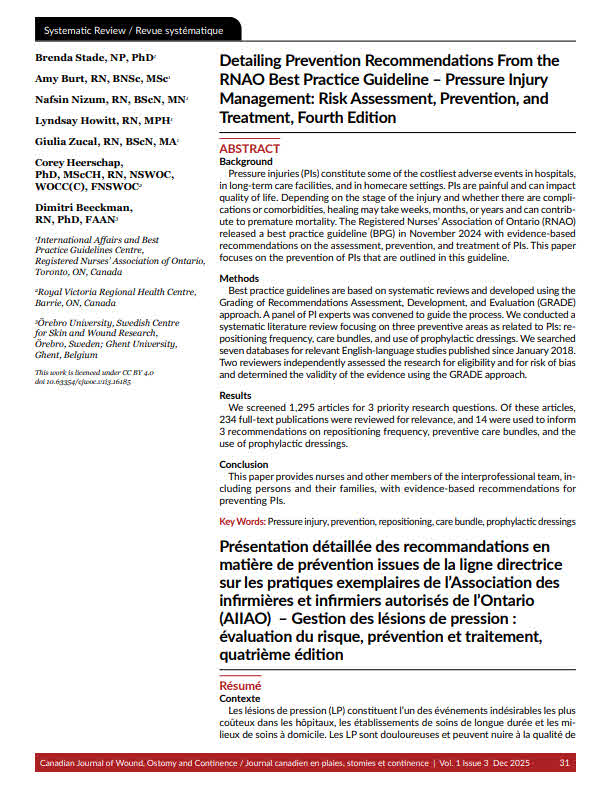
Pressure injuries (PIs) constitute some of the costliest adverse events in hospitals, in long-term care facilities, and in homecare settings. PIs are painful and can impact quality of life. Depending on the stage of the injury and whether there are complications or comorbidities, healing may take weeks, months, or years and can contribute to premature mortality. The Registered Nurses’ Association of Ontario (RNAO) released a best practice guideline (BPG) in November 2024 with evidence-based recommendations on the assessment, prevention, and treatment of PIs. This paper focuses on the prevention of PIs that are outlined in this guideline.
Methods
Best practice guidelines are based on systematic reviews and developed using the Grading of Recommendations Assessment, Development, and Evaluation (GRADE) approach. A panel of PI experts was convened to guide the process. We conducted a systematic literature review focusing on three preventive areas as related to PIs: repositioning frequency, care bundles, and use of prophylactic dressings. We searched seven databases for relevant English-language studies published since January 2018. Two reviewers independently assessed the research for eligibility and for risk of bias and determined the validity of the evidence using the GRADE approach.
Results
We screened 1,295 articles for 3 priority research questions. Of these articles, 234 full-text publications were reviewed for relevance, and 14 were used to inform 3 recommendations on repositioning frequency, preventive care bundles, and the use of prophylactic dressings.
Conclusion
This paper provides nurses and other members of the interprofessional team, including persons and their families, with evidence-based recommendations for preventing PIs.
References
1. European Pressure Ulcer Advisory Panel, National Pressure Injury Advisory Panel and Pan Pacific Pressure Injury Alliance. Prevention and Treatment of Pressure Ulcers/Injuries: Clinical Practice Guideline. The International Guideline. Emily Haesler, ed. EPUAP/NPIA/PPPIA; 2019.
2. Chung ML, Widdel M, Kirchhoff J, et al. Risk factors for pressure injuries in adult patients: a narrative synthesis. Int J Environ Res Public Health. 2022;19(2):761.
3. Registered Nurses’ Association of Ontario (RNAO). Pressure Injury Management: Risk Assessment, Prevention and Treatment. 4th Ed. RNAO; 2024.
4. National Pressure Injury Advisory Panel. NPIAP pressure injury stages, National Pressure Injury Advisory Panel. Accessed December 18, 2025. cdn.ymaws.com/npiap.com/resource/resmgr/online_store/npiap_pressure_injury_stages.pdf
5. Woodbury MG, Houghton PE. Prevalence of pressure ulcers in Canadian healthcare settings. Ostomy Wound Manage. 2004;50(10):22-24, 26, 28, 30, 32, 34, 36-38.
6. Health Quality Ontario (HQO). Pressure injuries: care for patients in all settings. Queen's Printer for Ontario, 2017. Accessed December 4, 2025. https://www.hqontario.ca/Portals/0/documents/evidence/quality-standards/qs-pressure-injuries-clinical-guide-en.pdf
7. Siotos C, Bonett AM, Damoulakis G, et al. Burden of pressure injuries: findings from the global burden of disease study. Eplasty. 2022;22:e19.
8. Padula WV, Pronovost PJ, Makic MBF, et al. Value of hospital resources for effective pressure injury prevention: a cost-effectiveness analysis. BMJ Qual Saf. 2019;28(2):132-141. doi:10.1136/bmjqs-2017-007505
9. Chan B, Ieraci L, Mitsakakis N, Pham B, Krahn M. Net costs of hospital-acquired and pre-admission PUs among older people hospitalised in Ontario. J Wound Care. 2013;22(7):341-2, 344-346. doi:10.12968/jowc.2013.22.7.341
10. Padula WV, Delarmente BA. The national cost of hospital-acquired pressure injuries in the United States. Int Wound J. 2019;16(3):634-640. doi:10.1111/iwj.13071
11. Health Quality Ontario (HQO), Canadian Patient Safety Institute (CPSI). Never events for hospital care in Canada: safer care for patients. CPSI, 2015. Accessed December 4, 2025. www.healthcareexcellence.ca/media/eceoshdc/never-events-for-hospital-care-in-canada.pdf
12. Healthcare Excellence Canada (HEC). Pressure ulcer: introduction. Accessed December 4, 2025. www.healthcareexcellence.ca/en/resources/hospital-harm-is-everyones-concern/hospital-harm-improvement-resource/pressure-ulcer-introduction/
13. Canadian Institute for Health Information. Worsened pressure ulcer in long-term care. Updated July 2025. Accessed December 4, 2025.
https://www.cihi.ca/en/indicators/worsened-pressure-ulcer-in-long-term-care
14. Howitt L, Burt A, Nizum N, Buchanan C, Rey M, Grinspun D. Best practice guideline development methods: An integrated approach based on the Registered Nurses' Association of Ontario's methods. Clin Pub Health Guidelines. 2026;3(1):e70052. doi:10.1002/gin2.70052
15. Schunemann H, Brozek J, Guyatt G, Oxman, A, eds. Handbook for Grading the Quality of Evidence and the Strength of Recommendations Using the GRADE Approach, 2013. Accessed December 4, 2025. https://gdt.gradepro.org/app/handbook/handbook.html
16. Neumann I, Santesso N, Akl EA, et al. A guide for health professionals to interpret and use recommendations in guidelines developed with the GRADE approach. J Clin Epidemiol. 2016 Apr;72:45-55. doi:10.1016/j.jclinepi.2015.11.017
17. Whiting P, Savović J, Higgins JPT, et al. ROBIS: A new tool to assess risk of bias in systematic reviews was developed. J Clin Epidemiol. 2016 Jan;69:225-234. doi:10.1016/j.jclinepi.2015.06.005
18. Sterne AC, Savović J, Page MJ, et al. RoB 2: a revised tool for assessing risk of bias in randomised trials. BMJ. 2019 Aug 28;366:I4898. doi:10.1136/bmj.l4898
19. Sterne AC, Hernán MA, Reeves BC, et al. ROBINS-I: a tool for assessing risk of bias in non-randomised studies of interventions. BMJ. 2016 Oct 12;355: i4919. doi:10.1136/bmj.i4919
20. Gillespie BM, Walker RM, Latimer SL, et al. Repositioning for pressure injury prevention in adults. Cochrane Database Syst Rev. 2020 Jun 2;6(6):CD009958 doi:10.1002/14651858.CD009958.pub3
21. Yap TL, Horn SD, Sharkey PD, et al. Effect of varying repositioning frequency on pressure injury prevention in nursing home residents: TEAM-UP trial results. Adv Skin Wound Care. 2022 Jun 1;35(6):315-325. doi:10.1097/01.ASW.0000817840.68588.04
22. Darvall JN, Mesfin L, Gorelik A. Increasing frequency of critically ill patient turns is associated with a reduction in pressure injuries. Crit Care Resusc. 2018 Sept;20(3):217-222.
23. Horner DL, Bellamy MC. Care bundles in intensive care. Contin Educ Anaesth Crit Care Pain. 2012 Aug;12(4):199-202.
24. Lin F, Zijing W, Song B, Coyer, F, Chaboyer W. The effectiveness of multicomponent pressure injury prevention programs in adult intensive care patients: a systematic review. Int J Nurs Stud. 2020;102:103483. doi:10.1016/j.ijnurstu.2019.103483
25. Pena H, Millard A, Richardson A. Implementation and evaluation of a pressure injury prevention bundle in the cardiothoracic intensive care unit. J Nurs Care Qual. 2024;39(1):1-3. doi:10.1097/NCQ.0000000000000727
26. Yilmazer T, Tuzer H. Effectiveness of a pressure injury prevention care bundle; prospective interventional study in intensive care units. J Wound Ostomy Continence Nurs. 2022;49(3):226-232. doi:10.1097/WON.0000000000000875
27. Zhang X, Wu Z, Zhao B, Zhang Q, Li Z. Implementing a pressure injury care bundle in Chinese intensive care units. Risk Manag Healthc Policy. 2021;14:2435-2442. doi:10.2147/RMHP.S292579
28. Singh C, Shoqirat N, Thorpe L, Villaneuva S. Sustainable pressure injury prevention. BMJ Open Qual. 2023;12(2):e002248. doi:10.1136/bmjoq-2022-002248
29. Aprea V, Barón FJ, Meregalli C, Sabatini, M. Impact of a health care quality improvement intervention to prevent pressure ulcers in a pediatric intensive care unit. Arch Argent Pediatr. 2018 Aug;116(4):e529-e541. doi:10.5546/aap.2018.eng.e529
30. Oozageer Gunowa N, Hutchinson M, Brooke J, Jackson, D. Pressure injuries in people with darker skin tones: a literature review. J Clin Nurs. 2018;27(17-18):3266-3275. doi:10.1111/jocn.14062
31. Kalowes P, Messina V, Li M. Five-layered soft silicone foam dressing to prevent pressure ulcers in the intensive care unit. Am J Crit Care. 2016;25(6):e108-19. doi:10.4037/ajcc2016875
32. Moore ZE, Webster J. Dressings and topical agents for preventing pressure ulcers. Cochrane Database Syst Rev. 2018 Dec 6;12(12):CD009362. doi: 10.1002/14651858.CD009362.pub3
33. Liao N, Wang F, He X, Li L, Fei J. Predictive application of foam dressing on preventing of auricle pressure injury caused by ear dressing. Heliyon. 2023;9(4):e14883. doi:10.1016/j.heliyon.2023.e14883
34. Hahnel E, El Genedy M, Tomova-Simitchieva T, et al. The effectiveness of two silicone dressings for sacral and heel pressure ulcer prevention compared with no dressings in high-risk intensive care unit patients: a randomized controlled parallel-group trial. Br J Dermatol. 2020;183(2):256-264. doi:10.1111/bjd.18621
35. Beeckman D, Fourie A, Raepsaet C, et al. Silicone adhesive multilayer foam dressings as adjuvant prophylactic therapy to prevent hospital-acquired pressure ulcers: a pragmatic noncommercial multicentre randomized open-label parallel-group medical device trial. Br J Dermatol. 2021 Jul;185(1):52-61. doi:10.1111/bjd.19689
36. Heerschap C, Nicholas A, Whitehead M. Wound management: investigating the interprofessional decision-making process. Int Wound J. 2019;16(1), 233-242. doi:10.1111/iwj.13017
37. Heerschap C, Woo KY. Formal caregiver experiences of caring for individuals at risk for or with a pressure injury: a metasynthesis. Adv Skin Wound Care. 2022;35(12): 680-687. doi:10.1097/01.ASW.0000855044.92545.af
38. Gilhooly D, Green SA, McCann C, Black N, Moonesinghe SR. Barriers and facilitators to the successful development, implementation and evaluation of care bundles in acute care in hospital: a scoping review. Implement Sci. 2019;14(1):47. doi:10.1186/s13012-019-0894-2
39. Kandula U. Impact of multifaceted interventions on pressure injury prevention: a systematic review. BMC Nurs. 2025;24(1):11. doi:10.1186/s12912-024-02558-9
Downloads
Published
How to Cite
Issue
Section
License
Copyright (c) 2026 Canadian Journal of Wound, Ostomy and Continence

This work is licensed under a Creative Commons Attribution 4.0 International License.