
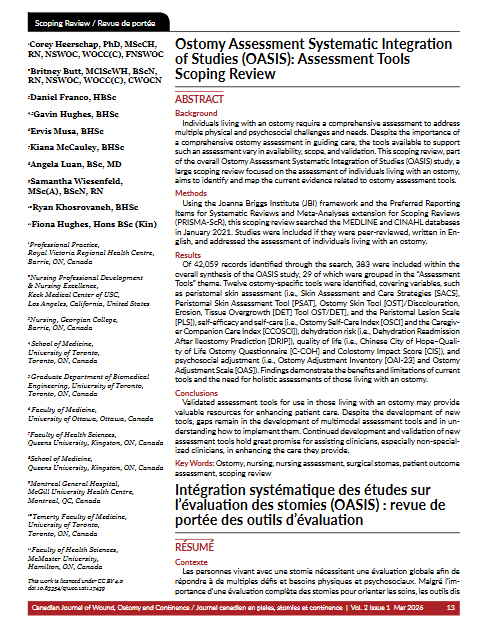
Ostomy Assessment Systematic Integration of Studies (OASIS): Assessment Tools Scoping Review
DOI:
https://doi.org/10.63354/cjwoc.v2i1.17439Keywords:
ostomy, nursing, nursing assessment, surgical stomas, patient outcome assessment, scoping reviewAbstract
Background
Individuals living with an ostomy require a comprehensive assessment to address multiple physical and psychosocial challenges and needs. Despite the importance of a comprehensive ostomy assessment in guiding care, the tools available to support such an assessment vary in availability, scope, and validation. This scoping review, part of the overall Ostomy Assessment Systematic Integration of Studies (OASIS) study, a large scoping review focused on the assessment of individuals living with an ostomy, aims to identify and map the current evidence related to ostomy assessment tools.
Methods
Using the Joanna Briggs Institute (JBI) framework and the Preferred Reporting Items for Systematic Reviews and Meta-Analyses extension for Scoping Reviews (PRISMA-ScR), this scoping review searched the MEDLINE and CINAHL databases in January 2021. Studies were included if they were peer-reviewed, written in English, and addressed the assessment of individuals living with an ostomy.
Results
Of 42,059 records identified through the search, 383 were included within the overall synthesis of the OASIS study, 29 of which were grouped in the “Assessment Tools” theme. Twelve ostomy-specific tools were identified, covering variables, such as peristomal skin assessment (i.e., Skin Assessment and Care Strategies [SACS], Peristomal Skin Assessment Tool [PSAT], Ostomy Skin Tool [OST]/Discolouration, Erosion, Tissue Overgrowth [DET] Tool OST/DET], and the Peristomal Lesion Scale [PLS]), self-efficacy and self-care (i.e., Ostomy Self-Care Index [OSCI] and the Caregiver Companion Care Index [CCOSCI]), dehydration risk (i.e., Dehydration Readmission After Ileostomy Prediction [DRIP]), quality of life (i.e., Chinese City of Hope–Quality of Life Ostomy Questionnaire [C-COH] and Colostomy Impact Score [CIS]), and psychosocial adjustment (i.e., Ostomy Adjustment Inventory [OAI-23] and Ostomy Adjustment Scale [OAS]). Findings demonstrate the benefits and limitations of current tools and the need for holistic assessments of those living with an ostomy.
Conclusions
Validated assessment tools for use in those living with an ostomy may provide valuable resources for enhancing patient care. Despite the development of new tools, gaps remain in the development of multimodal assessment tools and in understanding how to implement them. Continued development and validation of new assessment tools hold great promise for assisting clinicians, especially non specialized clinicians, in enhancing the care they provide.
References
1. Pittman JA. Ostomy complications and associated risk factors: development and testing of two instruments. Dissertation. Indiana University; 2011.
2. Registered Nurses’ Association of Ontario. Supporting adults who anticipate or live with an ostomy. 2nd ed. Registered Nurses’ Association of Ontario; 2019. Accessed March 13, 2026. https://rnao.ca/bpg/guidelines/ostomy
3. Peters MDJ, Godfrey C, McInerney P, Munn Z, Tricco AC, Khalil H. JBI Manual for Evidence Synthesis. 2024;417-476. doi:10.46658/JBI-MES-24-09
4. Tricco AC, Lillie E, Zarin W, et al. PRISMA extension for scoping reviews (PRISMA-ScR): checklist and explanation. Ann Intern Med. 2018;169(7):467-473. doi:10.7326/M18-0850
5. Elo S, Kyngäs H. The qualitative content analysis process. J Adv Nurs. 2008;62(1):107-115. doi:10.1111/j.1365-2648.2007.04569.x
6. Bradbury-Jones C, Aveyard H, Herber OR, et al. Scoping reviews: the PAGER framework for improving the quality of reporting. Int J Soc Res Methodol. 2022;25(4):457-470. doi:10.1080/13645579.2021.1899596
7. Inch T. Use of the Ostomy Skin Tool: four patient cases. Gastrointest Nurs. 2013;11(9):15-16.
8. Kelleher K, Hunt R, Hannigan A, et al. A single-arm, practical application assessment of user experience and peristomal skin condition among persons with an ileostomy using a new barrier seal with assisted flow. Wound Manag Prev. 2019;65(1):14-19. doi:10.52270/wmp.2019.1.1419
9. McDonald A. Orchestrating the management of patients with high-output stomas. Br J Nurs. 2014;23(12):645-646;648-649.
10. Beitz J, Gerlach M, Ginsburg P, et al. Content validation of a standardized algorithm for ostomy care. Ostomy Wound Manage. 2010;56(10):22-38.
11. Dellafiore F, Pittella F, Arrigoni C, et al. A multi-phase study for the development of a self-efficacy measuring scale for ostomy care nursing management. J Adv Nurs. 2020;76(1):409-419. doi:10.1111/jan.14242
12. Nafees B, Rasmussen M, Lloyd A. The Ostomy–Q: development and psychometric validation of an instrument to evaluate outcomes associated with ostomy appliances. Ostomy Wound Manage. 2017;63(1):12-22.
13. Nafees B, Størling ZM, Hindsberger C, Lloyd A. The ostomy leak impact tool: development and validation of a new patient-reported tool to measure the burden of leakage in ostomy device users. Health Qual Life Outcomes. 2018;16(1):231. doi:10.1186/s12955-018-1054-0
14. Osborne W, North J, Williams J. Using a risk assessment tool for parastomal hernia prevention. Br J Nurs. 2018;27(5):15-19.
15. Menin G, Roveron G, Barbierato M, Peghetti A, Zanotti R. Design and validation of a “Peristomal Lesion Scale” for peristomal skin assessment. Int Wound J. 2019;16(2):433-441. doi:10.1111/iwj.13052
16. Colquhoun P, Kaiser R, Weiss EG, et al. Correlating the fecal incontinence quality-of-life score and the SF-36 to a proposed ostomy function index in patients with a stoma. Ostomy Wound Manage. 2006;52(12):68-74.
17. Nagle D, Pare T, Keenan E, Marcet K, Tizio S, Poylin V. Ileostomy pathway virtually eliminates readmissions for dehydration in new ostomates. Dis Colon Rectum. 2012;55(12):1266-1272. doi:10.1097/DCR.0b013e31827080c1
18. Chen SY, Stem M, Cerullo M, et al. Predicting the risk of readmission from dehydration after ileostomy formation: the dehydration readmission after ileostomy prediction score. Dis Colon Rectum. 2018;61(12):1410-1417. doi:10.1097/DCR.0000000000001217
19. Pittman J. Characteristics of the patient with an ostomy. J Wound Ostomy Continence Nurs. 2011;38(3):271-279. doi:10.1097/WON.0b013e3182152bbf
20. Kapsandoy SC. Feasibility and psychometric evaluation of the Studio Alterazioni Cutanee Stomali (SACSTM) instrument for assessment of peristomal skin lesions in children. Dissertation. University of Utah; 2015.
21. Beitz JM, Gerlach MA, Schafer V. Construct validation of an interactive digital algorithm for ostomy care. J Wound Ostomy Continence Nurs. 2014;41(1):49-54. doi:10.1097/01.WON.0000438016.75487.cc
22. Pittman J, Bakas T, Ellett M, Sloan R, Rawl SM. Psychometric evaluation of the ostomy complication severity index. J Wound Ostomy Continence Nurs. 2014;41(2):147-157. doi:10.1097/WON.0000000000000008
23. Villa G, Vellone E, Sciara S, et al. Two new tools for self-care in ostomy patients and their informal caregivers: psychosocial, clinical, and operative aspects. Int J Urol Nurs. 2019;13(1):23-30. doi:10.1111/ijun.12177
24. Gonella F, Valenti A, Massucco P, et al. A novel patient-centered protocol to reduce hospital readmissions for dehydration after ileostomy. Updates Surg. 2019;71(3):515-521. doi:10.1007/s13304-019-00643-2
25. Bosio G, Pisani F, Lucibello L, et al. A proposal for classifying peristomal skin disorders: results of a multicenter observational study. Ostomy Wound Manage. 2007;53(9):38-43.
26. Thyø A, Emmertsen KJ, Pinkney TD, Christensen P, Laurberg S. The colostomy impact score: development and validation of a patient reported outcome measure for rectal cancer patients with a permanent colostomy. a population-based study. Colorectal Dis. 2017;19(1):O25-O33. doi:10.1111/codi.13566
27. Simmons KL, Smith JA, Maekawa A. Development and psychometric evaluation of the Ostomy Adjustment Inventory-23. J Wound Ostomy Continence Nurs. 2009;36(1):69-76.
28. Kalashnikova I, Achkasov S, Fadeeva S, Vorobiev G. The development and use of algorithms for diagnosing and choosing treatment of ostomy complications: results of a prospective evaluation. Ostomy Wound Manage. 2011;57(1):20-27.
29. St-Cyr D. An evaluation of the Canadian Ostomy Guide. Ostomy Wound Manage. 2002;48(8):26-32.
30. Invernizzi Silveira N, Boghossiam Lanza L. Cross-cultural adaptation, content validity index, and interobserver reliability of The SACSTM Instrument: assessing and classifying peristomal skin lesion. Estima-Brazilian J Enterostomal Ther. 2019;17:e1919. doi:10.30886/estima.v17.768_IN
31. Sodhi JK, Sharma P. A methodological study to develop a peristomal skin assessment tool for patients with colostomy in selected hospital, Ludhiana, Punjab. Int J Nurs Educ. 2012;4(2):209-212.
32. Martins L, Ayello EA, Claessens I, et al. The ostomy skin tool: tracking peristomal skin changes. Br J Nurs. 2010;19(15):932-934, 960.
33. Jemec GB, Martins L, Claessens I, et al. Assessing peristomal skin changes in ostomy patients: validation of the ostomy skin tool. Br J Dermatol. 2011;164:330-335. doi:10.1111/j.1365-2133.2010.10093.x
34. Gao W, Yuan C, Wang J, et al. A Chinese version of the City of Hope Quality of Life-Ostomy Questionnaire: validity and reliability assessment. Cancer Nurs. 2013;36(1):41-51.
35. Zhang J, Wong FKY, Zheng M, Hu A, Zhang H. Psychometric evaluation of the ostomy adjustment scale in Chinese cancer patients with colostomies. Cancer Nurs. 2015;38(5):395-405. doi:10.1097/NCC.0000000000000213
36. Harputlu D, Özsoy SA. Care of a case of peristomal allergic contact dermatitis using the ostomy skin tool. WCET J. 2015;35(3):10-13.
37. Giordano V, Nicolotti M, Corvese F, Vellone E, Alvaro R, Villa G. Describing self-care and its associated variables in ostomy patients. J Adv Nurs. 2020;76(11):2982-2992. doi:10.1111/jan.14499
38. Hyde LZ, Al-Mazrou AM, Kuritzkes BA, et al. Readmissions after colorectal surgery: not all are equal. Int J Colorectal Dis. 2018;33(12):1667-1674. doi:10.1007/s00384-018-3150-3
39. Goodman W, Downing A, Allsop M, et al. Quality of life profiles and their association with clinical and demographic characteristics and physical activity in people with a stoma: a latent profile analysis. Qual Life Res. 2022;31(8):2435-2444. doi:10.1007/s11136-022-03102-5
40. Stott C, Kittscha J, Graaf L, et al. The trajectory of adjustment outcomes among new ostomy patients: a prospective study. J Wound Ostomy Continence Nurs. 2025;52(2):126-132. doi:10.1097/WON.0000000000001151
41. Lisboa CR, Spira JAO, Borges EL. Self-care concept for people with elimination ostomy: a scoping review. Rev Esc Enferm USP. 2024;58:e20240041. doi:10.1590/1980-220X-REEUSP-2024-0041en
42. Heerschap C, Butt B. Algorithmic approaches to ostomy management: an integrative review. Nurs Open. 2021;8(6):2912-2921. doi:10.1002/nop2.1044
Downloads
Published
How to Cite
Issue
Section
License
Copyright (c) 2026 Canadian Journal of Wound, Ostomy and Continence

This work is licensed under a Creative Commons Attribution 4.0 International License.