
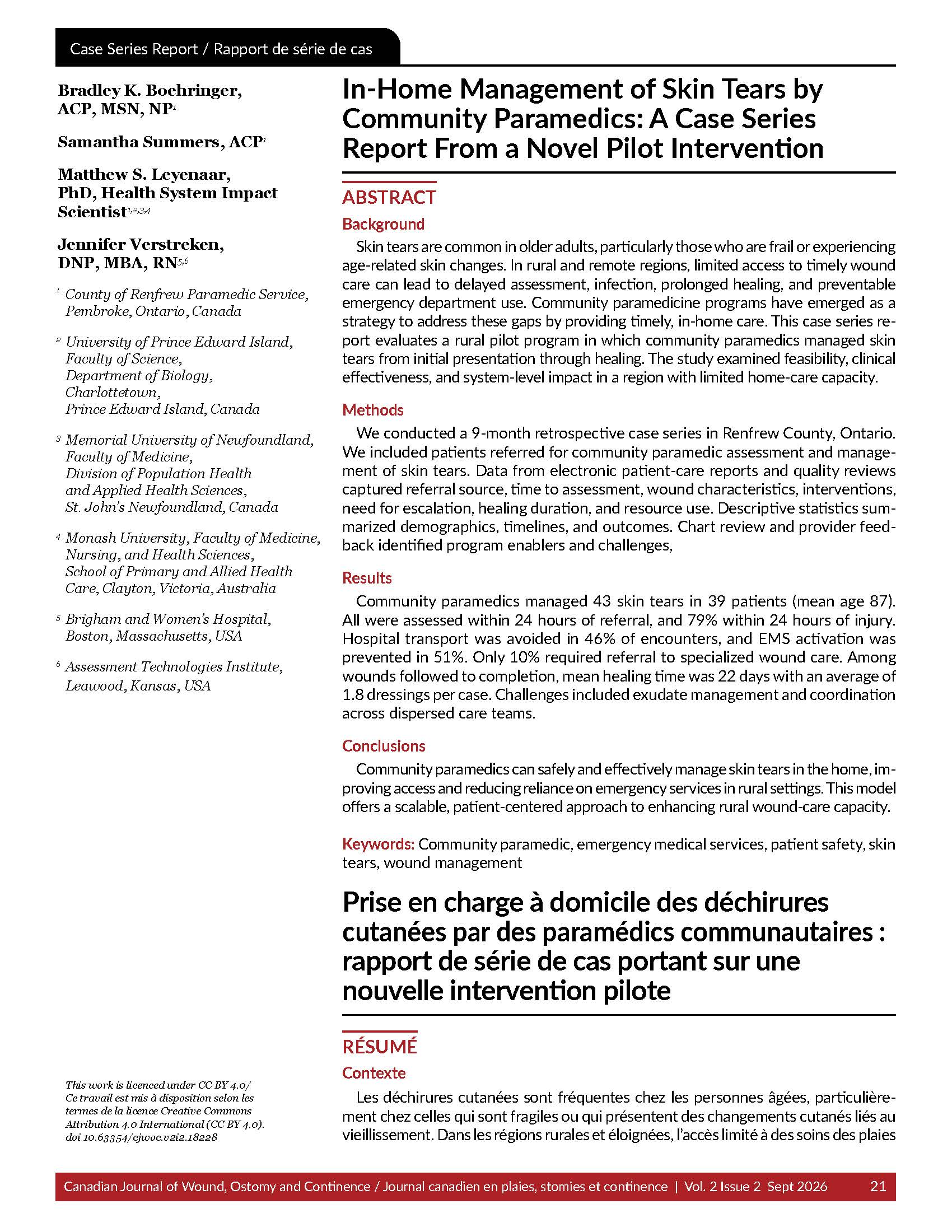
In-Home Management of Skin Tears by Community Paramedics: a case series report from a novel pilot intervention
DOI:
https://doi.org/10.63354/cjwoc.v2i2.18228Keywords:
community paramedic, emergency medical services, patient safety, skin tears, wound managementAbstract
Abstract
Background: Skin tears are common in older adults, particularly those who are frail or experiencing age‑related skin changes. In rural and remote regions, limited access to timely wound care can lead to delayed assessment, infection, prolonged healing, and preventable emergency department use. Community paramedicine programs have emerged as a strategy to address these gaps by providing timely, in‑home care. This case series evaluates a rural pilot program in which community paramedics managed skin tears from initial presentation through healing. The study examined feasibility, clinical effectiveness, and system‑level impact in a region with limited home‑care capacity.
Methods: A nine‑month retrospective case series was conducted in Renfrew County, Ontario. Patients referred for community‑paramedic assessment and management of skin tears were included. Data from electronic patient care reports and quality reviews captured referral source, time to assessment, wound characteristics, interventions, need for escalation, healing duration, and resource use. Descriptive statistics summarized demographics, timelines, and outcomes. Program enablers and challenges were identified through chart review and provider feedback.
Results: Community paramedics managed 43 skin tears in 39 patients (mean age 87). All were assessed within 24 hours of referral, and 79% within 24 hours of injury. Hospital transport was avoided in 46% of encounters, and EMS activation was prevented in 51%. Only 10% required referral to specialized wound care. Among wounds followed to completion, mean healing time was 22 days with an average of 1.8 dressings per case. Challenges included exudate management and coordination across dispersed care teams.
Conclusions: Community paramedics can safely and effectively manage skin tears in the home, improving access and reducing reliance on emergency services in rural settings. This model offers a scalable, patient‑centered approach to enhancing rural wound care capacity.
References
1. Carville K. SHJ. Skin Tears Made Easy. Wounds Internatiaonal. 2011;2(4):1-6.
2. Lichterfeld A, Hauss A, Surber C, Peters T, Blume-Peytavi U, Kottner J. Evidence-Based Skin Care: A Systematic Literature Review and the Development of a Basic Skin Care Algorithm. Journal of Wound, Ostomy and Continence Nursing. 2015;42(5):501-524. doi:10.1097/WON.0000000000000162 DOI: https://doi.org/10.1097/WON.0000000000000162
3. Carville K, Leslie G, Osseiran-Moisson R, Newall N, Lewin G. The effectiveness of a twice-daily skin-moisturising regimen for reducing the incidence of skin tears. Int Wound J. 2014;11(4):446-453. doi:10.1111/iwj.12326 DOI: https://doi.org/10.1111/iwj.12326
4. Leblanc K. Skin Tear Prevalence, Incidence and Associated Risk Factors in the Long-Term Care Population. Published online 2017.
5. Carville, C., Lewin G. Caring In the Community: a prevalence study. Primary Intention. 1998;6:54-62.
6. Leblanc K, Canada C, Christensen D, Orsted HL, Keast DH. Best practice recommendation for the preention and treatment of skin tears. Wound Care Canada. 2008;6(January):14-32.
7. Hickey T, Ayres J. Who should be the first responders for the management of skin tears? J Wound Care. 2021;30(5):332-336. doi:10.12968/jowc.2021.30.5.332 DOI: https://doi.org/10.12968/jowc.2021.30.5.332
8. Strazzieri-Pulido KC, Peres GRP, Campanili TCGF, De Gouveia Santos VLC. Incidence of skin tears and risk factors: A systematic literature review. Journal of Wound, Ostomy and Continence Nursing. 2017;44(1):29-33. doi:10.1097/WON.0000000000000288 DOI: https://doi.org/10.1097/WON.0000000000000288
9. Rayner R, Carville K, Leslie G, Roberts P. A review of patient and skin characteristics associated with skin tears. J Wound Care. 2015;24(9):406-414. doi:10.12968/jowc.2015.24.9.406 DOI: https://doi.org/10.12968/jowc.2015.24.9.406
10. LeBlanc K et al. Best Practice Guidelines for the Prevention and Management of Skin Tears in Aged Skin. Wounds Internatiaonal. Published online 2018:1-24.
11. Van Tiggelen H, LeBlanc K, Campbell K, et al. Standardizing the classification of skin tears: validity and reliability testing of the International Skin Tear Advisory Panel Classification System in 44 countries. British Journal of Dermatology. 2020;183(1):146-154. doi:10.1111/bjd.18604 DOI: https://doi.org/10.1111/bjd.18604
12. Mangan M, Shoreman S. Empowering residential care home staff to manage patients with skin tears: Reducing the need for unscheduled district nursing visits. Wounds UK. 2021;17(3):44-50.
13. Downie F, Schroder K, Barella D. Advanced paramedics and wound care: What is their role? Wounds UK. 2021;17(2):66-68.
14. Jansz C, United H, Ross A, et al. Skin Tears in an aging population: Workforce empowerment - Evaluation of a First Responder Skin Tear Wound Management Pack. Journal of Wound Management Official journal of the European Wound Management Association. 2022;23(July 2022):60-69. doi:10.35279//jowm2022.23.02.03 DOI: https://doi.org/10.35279//jowm2022.23.02.03
15. Guest JF, Fuller GW, Vowden P. Cohort study evaluating the burden of wounds to the UK’s National Health Service in 2017/2018: Update from 2012/2013. BMJ Open. 2020;10(12):1-15. doi:10.1136/bmjopen-2020-045253 DOI: https://doi.org/10.1136/bmjopen-2020-045253
16. Collins K, Downie F, Hickey T. The classification of, and dressing choice, for skin tears in the pre-hospital setting. Wounds UK. 2021;17(4):94-100.
17. Carville K. SHJ. Skin Tears Made Easy. Wounds Internatiaonal. 2011;2(4):1-6.
18. LeBlanc K, Woo K, Christensen D, et al. Best practice recommendations for the prevention and management of skin tears. Foundations of Best Practice for Skin and Wound Management A Supplement of Wound Care Canada. Published online 2017:1-46. www.woundscanada.ca/ docman/public/health-care-professional/bpr-workshop/552-bpr-prevention-and- management-of-skin-tears/file.
19. Canadian Institutes of Health Research, Natural Sciences and Engineering Research Council of Canada, Social Sciences and Humanities Research Council of Canada. Tri-Council Policy Statement: Ethical Conduct for Research Involving Humans—TCPS 2 2022. Government of Canada; 2022. Accessed August 12, 2026. https://ethics.gc.ca/eng/tcps2-eptc2_2022_chapter2-chapitre2.html
20. Leyenaar M, McLeod B, Chan J, Tavares W, Costa A, Agarwal G. A scoping study and qualitative assessment of care planning and case management in community paramedicine. Ir J Paramed. 2018;3(1). DOI: https://doi.org/10.32378/ijp.v3i1.76
21. Rasku T, Kaunonen M, Thyer E, Paavilainen E, Joronen K. The core components of community paramedicine: integrated care in primary care setting: a scoping review. Scand J Caring Sci. 2019;33(3):508-521. doi:10.1111/scs.12659 DOI: https://doi.org/10.1111/scs.12659
22. Xi D, McCombe G, Agarwal G, et al. Paramedics working in general practice: a scoping review. HRB Open Res. 2021;4:34. doi:10.12688/hrbopenres.13250.1 DOI: https://doi.org/10.12688/hrbopenres.13250.1
23. Shannon B, Baldry S, O’Meara P, et al. The definition of a community paramedic: an international consensus. Paramedicine. 2023;20(1):4-22. doi:10.1177/27536386221148993 DOI: https://doi.org/10.1177/27536386221148993
24. Philip S, Konikoff L, Tiukuvaara S, et al. A qualitative RE-AIM evaluation of an embedded community paramedicine program in an Ontario Family Health Team. BMC Prim Care. 2025;26(1):82. doi:10.1186/s12875-025-02777-2 DOI: https://doi.org/10.1186/s12875-025-02777-2
25. Leyenaar MS, McLeod B, Jones A, et al. Paramedics assessing patients with complex comorbidities in community settings: results from the CARPE study. CJEM. 2021;23(6):828-836. DOI: https://doi.org/10.1007/s43678-021-00153-4
26. Leyenaar MS, McLeod B, Penhearow S, et al. What do community paramedics assess? An environmental scan and content analysis of patient assessmentin community paramedicine. Can J Emerg Med. 2019;21(6):766-775. DOI: https://doi.org/10.1017/cem.2019.379
27. Leyenaar MS, McLeod B, Poss J, et al. Paramedic lift assist calls: outcomesand interventions. Zenodo. Accessed July 30, 2026. https://zenodo.org/records/18891311
28. Rehabilitative Care Alliance. Paramedic Post-Fall Pathway Toolkit. Accessed July 30, 2026. https://rehabcarealliance.ca/wp-content/uploads/2025/04/Community-Paramedicine-Toolkit.pdf
29. Quatman-Yates CC, Wisner D, Weade M, et al. Assessment of fall-related emergency medical service calls and transports after a community-level fall-prevention initiative. Prehosp Emerg Care. 2022;26(3):410-421. doi:10.1080/10903127.2021.1922556 DOI: https://doi.org/10.1080/10903127.2021.1922556
Downloads
Published
How to Cite
Issue
Section
License
Copyright (c) 2026 Canadian Journal of Wound, Ostomy and Continence

This work is licensed under a Creative Commons Attribution 4.0 International License.